






Computational Fluid Dynamics Internship: What Students Can Expect and How to Prepare
A computational fluid dynamics internship can be an excellent opportunity for engineering students to connect classroom theory with practical engineering applications. Computational Fluid Dynamics (CFD) is widely used to study fluid flow, heat transfer, pressure distribution, turbulence, and other physical phenomena through numerical simulations. For students interested in mechanical engineering, aerospace engineering, automotive design, energy systems, chemical engineering, or related technical fields, an internship can provide valuable experience before entering the professional world.
However, getting the most from an internship requires more than simply knowing how to operate simulation software. Students should understand fundamental engineering principles, develop problem-solving skills, become comfortable with technical tools, and learn how simulation results are interpreted and communicated.
What Is a Computational Fluid Dynamics Internship?
A computational fluid dynamics internship typically allows students to work with engineers, researchers, or simulation specialists on projects involving numerical analysis of fluid behavior. Depending on the organization, interns may participate in activities ranging from basic geometry preparation to complete CFD simulation workflows.
The exact responsibilities can vary considerably. Some internships focus heavily on learning software, while others involve research, product development, optimization, or validation. Students may work with internal engineering teams to analyze components, identify performance problems, compare design alternatives, or understand complex flow behavior.
The experience is particularly valuable because it demonstrates how theoretical concepts such as fluid mechanics, thermodynamics, heat transfer, and numerical methods are applied to real engineering problems.
What Students Can Expect During the Internship
One of the first things students can expect is an introduction to the organization’s simulation process. Engineers generally follow a structured workflow that begins with defining the engineering problem and ends with analyzing and communicating the results.
Interns may initially spend time understanding project requirements, geometry, operating conditions, material properties, and expected performance criteria. They may then prepare computational models and establish appropriate boundary conditions.
Another important part of the experience is learning how to identify whether a simulation setup is physically reasonable. Simply producing colorful contours or numerical results does not guarantee that a simulation is correct. Students learn to question assumptions, check mesh quality, evaluate convergence, and compare results against expected physical behavior.
Learning CFD Software and Simulation Tools
Software training is often an important part of an internship. Students may encounter commercial or open-source CFD platforms depending on the organization and project.
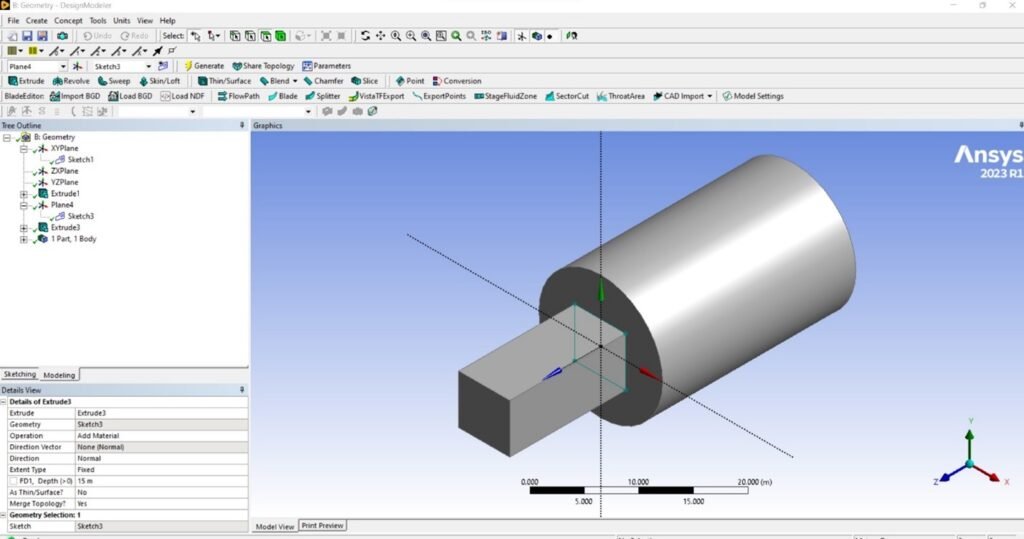
A student might learn how to import or create geometry, generate computational meshes, define fluid properties, configure boundary conditions, select appropriate physical models, run simulations, and visualize results.
For students beginning a computational fluid dynamics internship, the software interface can initially seem complicated. The best approach is to understand the engineering purpose behind each setting rather than simply memorizing menu options.
Learning the workflow is more valuable than memorizing individual commands because different projects can require different modeling approaches.
Building a Strong Foundation Before Starting
Preparation should begin before the internship. Students should review fundamental fluid mechanics concepts, including continuity, momentum conservation, energy equations, pressure relationships, viscosity, Reynolds number, boundary layers, and turbulence.
Basic thermodynamics and heat-transfer knowledge can also be useful, particularly when working on thermal-fluid systems.
Students should also understand the difference between steady and transient simulations, laminar and turbulent flow, compressible and incompressible flow, and internal and external flows. These concepts help interns understand why particular models are selected.
A basic understanding of numerical methods is equally valuable. Concepts such as discretization, convergence, residuals, numerical stability, and mesh independence can make the learning process much easier.
Developing Mesh and Geometry Skills
Mesh generation is one of the most important technical areas students encounter. A computational model divides the physical domain into many smaller cells where governing equations are solved numerically.
During an internship, students may learn how to create structured or unstructured meshes and how to refine regions where important physical phenomena occur. Areas near walls, sharp edges, wakes, separation zones, and strong gradients may require additional attention.
Students should understand that a finer mesh is not automatically a better mesh. Computational cost, numerical accuracy, geometry complexity, and the physics of the problem all need to be considered.
Learning to perform mesh-quality checks and mesh-independence studies can therefore become an important part of professional CFD development.
Working With Real Engineering Problems
One major difference between academic assignments and professional projects is the uncertainty involved in real engineering problems. In a classroom exercise, many parameters are usually provided. In an industrial environment, students may need to determine which information is relevant and identify missing data.
An intern could be asked to investigate pressure loss through a component, evaluate airflow around a vehicle, study cooling performance, analyze heat transfer, or compare different design configurations.
The goal may not always be to obtain one perfect answer. Instead, the team may want to understand trends, compare alternatives, identify potential problems, or support a design decision.
This teaches students how CFD functions as an engineering decision-making tool rather than simply a software exercise.
Post-Processing and Interpreting Results
After completing a simulation, students need to understand what the results actually mean. Post-processing can involve examining velocity contours, pressure distributions, temperature fields, streamlines, turbulence quantities, forces, flow rates, and other engineering variables.
An internship can teach students how to identify meaningful patterns instead of focusing only on attractive visualizations.
For example, a pressure difference may indicate a performance issue, while a velocity distribution could reveal separation or recirculation. Similarly, temperature contours may help identify areas where cooling performance needs improvement.
Students should learn to connect simulation results back to the original engineering question.
Communication Is Just as Important as Technical Skills
A successful computational fluid dynamics internship is not only about technical knowledge. Communication skills are also essential.
Interns may need to prepare reports, create presentations, explain simulation assumptions, document workflows, and discuss results with engineers who may not specialize in CFD.
A technically impressive simulation becomes much more useful when its methodology and conclusions can be clearly explained.
Students should therefore practice presenting their work using straightforward language, well-selected figures, relevant numerical results, and clearly stated conclusions.
How to Prepare for a CFD Internship
Students can take several practical steps before starting their internship. First, review core engineering subjects and make sure fundamental concepts are clear.
Second, gain hands-on experience with at least one CFD platform through academic projects, tutorials, or personal practice. Even a small project can demonstrate initiative.
Third, become comfortable with spreadsheets, basic programming, and data analysis. Python or another programming language can be particularly useful for processing simulation results and automating repetitive tasks.
Fourth, learn how to document technical work. Keep track of assumptions, boundary conditions, mesh settings, solver choices, convergence behavior, and important results.
Finally, develop the habit of asking why. Instead of accepting simulation results immediately, students should ask whether the setup is physically appropriate and whether the results make sense.
Common Challenges Students May Face
CFD can have a steep learning curve. New interns may initially struggle with unfamiliar terminology, complex software interfaces, convergence problems, or unexpected results.
Simulation errors can arise from poor geometry, inappropriate boundary conditions, inadequate mesh quality, unsuitable physical models, or numerical settings.
These challenges are normal. Students should treat troubleshooting as part of the learning process. Working systematically through potential causes is often more productive than changing multiple settings at once.
Another challenge is managing computational resources. Large simulations can require substantial processing time, so interns may need to balance accuracy with practical computational costs.
Career Benefits of the Experience
A computational fluid dynamics internship can strengthen both technical knowledge and employability. Students gain exposure to engineering workflows, simulation methodology, technical communication, and project-based problem solving.
The experience can also help students determine whether CFD is the right career direction. Those who enjoy analyzing physical systems, solving numerical problems, and working with engineering software may find opportunities in aerospace, automotive engineering, energy, manufacturing, HVAC, marine engineering, chemical processing, and research.
An internship project can also become a valuable portfolio item when applying for graduate programs or entry-level engineering positions.
Conclusion
A computational fluid dynamics internship gives students an opportunity to move beyond theoretical learning and experience how numerical simulation is applied to practical engineering challenges. Students can expect to work with geometry, meshing, physical models, solvers, post-processing, validation, documentation, and technical communication.
The strongest preparation combines fundamental engineering knowledge with hands-on software practice and a willingness to investigate problems carefully. By developing both technical and communication skills, students can turn their internship experience into a strong foundation for future CFD education and engineering careers.