





Building a Strong Foundation: The Significance of Rhythm Training for Musicians
Rhythm forms the backbone of musical expression. Across genres, from classical orchestras to jazz ensembles, and from contemporary pop to Indian classical music, the ability to internalize, manipulate, and articulate rhythm is essential. For musicians, rhythm training is not merely a technical exercise; it is a foundational skill that informs timing, phrasing, and overall musicality. In this context, structured rhythm education, informed by both Western conservatory methods and Indian percussion training, can profoundly enhance a musician’s craft.
The Role of Rhythm in Musical Development
At its core, rhythm is the organization of sound in time. In ensemble settings, precise rhythmic execution ensures cohesion among performers. In solo performance, it provides expressive freedom and structural clarity. Western conservatories emphasize rhythm through sight-reading exercises, metronomic practice, and ensemble coordination. Students progress from simple subdivisions to complex polyrhythms, gradually developing an internal clock that supports interpretive choices and improvisational skills.
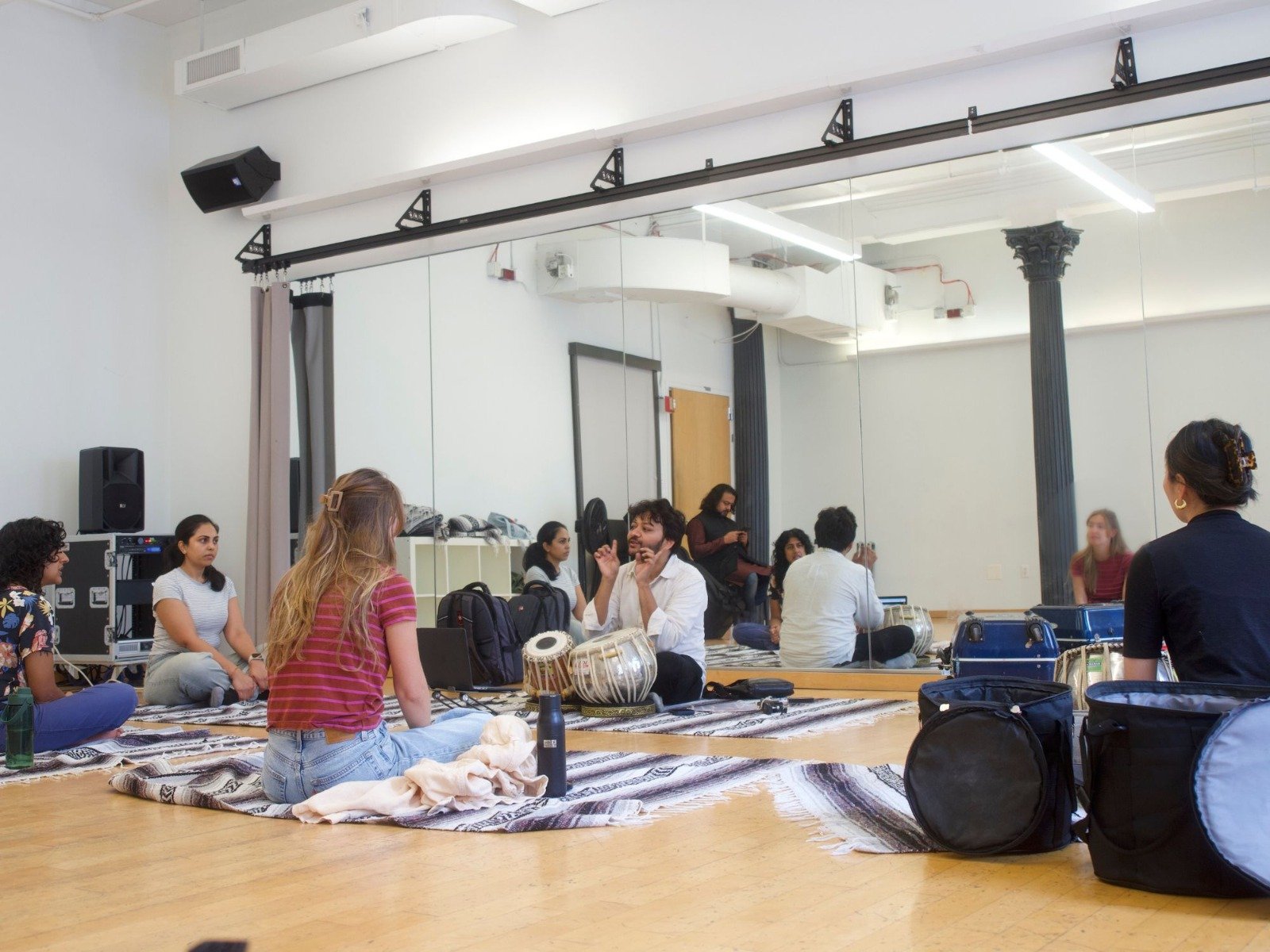
Indian percussion training, particularly in tabla or mridangam, introduces rhythmic concepts that are deeply mathematical and highly nuanced. Talas, the rhythmic cycles in Indian classical music, demand acute awareness of beats, accents, and subdivisions. These patterns encourage a level of precision and improvisational agility that complements Western approaches, offering musicians a broader palette for rhythmic expression.
Curriculum Design for Rhythm Training
Effective rhythm training begins with a clear curriculum that balances theory, practice, and application. Western conservatory programs often structure rhythm education across multiple stages: introductory rhythmic exercises, sight-reading, polyrhythmic training, and ensemble performance. Each stage builds upon the previous, ensuring that students develop both technical accuracy and musical intuition.
Introducing Indian percussion training into this curriculum enriches the learning experience. Practicing tala cycles and rhythmic improvisations enhances cognitive flexibility, auditory discrimination, and coordination. For example, the concept of “tihai”—a rhythmic cadence repeated three times to land on a specific beat—teaches musicians to think in nested patterns, sharpening timing and predictive abilities. By integrating these methods, students cultivate a rhythmic foundation that is both disciplined and adaptable.
Technique and Physical Coordination
Rhythm training is inseparable from technique. A musician’s physical facility—be it finger placement on a piano, bow control on a violin, or hand coordination on percussion—is essential for executing rhythms accurately. Western conservatories emphasize technical exercises that isolate motor skills, gradually increasing tempo and complexity. Drills like metronome exercises, subdivisions, and accent patterns train muscle memory while reinforcing internal pulse.
Indian percussion training adds a layer of dexterity and independence. Techniques such as intricate finger rolls, hand alternation patterns, and cross-rhythms develop fine motor control and ambidexterity. Even for non-percussionists, exposure to these exercises improves limb coordination, timing accuracy, and responsiveness to rhythmic cues in ensemble contexts. The combination of Western technique drills and Indian percussion methodologies creates a holistic approach to rhythm mastery.
Ensemble Integration and Communication
No rhythm exists in isolation. In ensemble settings, musicians must synchronize with others while maintaining individual rhythmic integrity. Rhythm training, therefore, must emphasize listening, cueing, and adaptation. Western conservatories achieve this through chamber music, orchestra participation, and jazz ensembles, where students must negotiate tempo changes, syncopations, and dynamic shifts in real time.
Incorporating principles from Indian percussion training enhances these skills. Percussionists trained in tala cycles often play improvisational interludes while maintaining the underlying rhythmic structure, a skill that translates effectively into Western ensemble contexts. Musicians learn to anticipate, respond, and contribute creatively to the collective sound. The combination of Western ensemble discipline and Indian rhythmic fluidity fosters musicianship that is both precise and expressive.
Progression and Advanced Applications
Rhythm training is cumulative. Early exercises focus on clarity of beat, subdivision, and simple coordination. Intermediate levels introduce syncopation, polyrhythms, and metric modulation. Advanced training challenges musicians to navigate complex temporal structures, integrate improvisation, and apply rhythmic concepts to expressive phrasing.
Indian percussion training supports advanced progression by offering a repertoire of rhythmic patterns that can be adapted to various musical contexts. Practicing tihai compositions, complex rhythmic cycles, and improvisational cadences develops analytical listening and anticipatory skills. For composers and performers alike, these techniques provide tools for innovation, allowing rhythmic ideas to transcend traditional boundaries.
Cognitive and Artistic Benefits
Beyond technical mastery, rhythm training fosters cognitive and artistic growth. Studies show that musicians with strong rhythmic skills exhibit enhanced memory, attention, and neural synchronization. They can internalize musical structures more efficiently and execute them with precision.
The interplay of Western and Indian training amplifies these benefits. While Western methods emphasize metric accuracy, sight-reading, and ensemble coordination, Indian percussion training cultivates flexibility, improvisational thinking, and deep internalization of temporal cycles. Together, these approaches enhance musicians’ creativity, interpretive insight, and expressive capabilities.
Integrating Rhythm Training into Daily Practice
To achieve proficiency, rhythm training should be a consistent component of daily practice. Exercises can include metronome drills, subdivided counting, clapping patterns, and playing along with recordings. Incorporating Indian percussion techniques—such as practicing basic tabla bols or reciting rhythmic syllables—can provide a refreshing variation and deepen rhythmic understanding.
For educators, designing practice routines that blend Western technical exercises with Indian percussion principles can accelerate development. Students benefit from alternating between structured, metric-focused drills and fluid, improvisational patterns. This integration reinforces both precision and creativity, ensuring that rhythm becomes an internalized, expressive skill rather than a mechanical task.
Conclusion
Building a strong rhythmic foundation is essential for musicians at every stage of development. Through structured curriculum, technical training, ensemble experience, and progressive exercises, musicians cultivate the precision and flexibility needed for expressive performance. Incorporating Indian percussion training into rhythm education offers unique benefits, providing a nuanced understanding of temporal patterns, improvisational strategies, and cognitive coordination.
Ultimately, the study of rhythm transcends technique; it shapes how musicians perceive, interact with, and communicate music. By combining Western conservatory methods with the rich traditions of Indian percussion, musicians can develop a foundation that supports both artistic excellence and innovative expression. Whether in solo performance, chamber music, or orchestral settings, a disciplined yet adaptable rhythmic sensibility remains the cornerstone of musical mastery.